
There are more than 1 billion disabled people across the world, yet only 1 in 10 have access to the assistive products they need, according to the WHO-UNICEF Global Report on Assistive Technology. For people in the Global South, queer disabled folks, and those navigating intersecting identities, this gap is even wider.
As a wheelchair user and disability rights advocate from India, I’ve experienced firsthand how stigma, affordability, and policy neglect make assistive aids hard to access. From mobility devices to communication tools, assistive technology plays a crucial role in enabling disabled people to live with dignity and independence. This issue is deeply personal and structural.
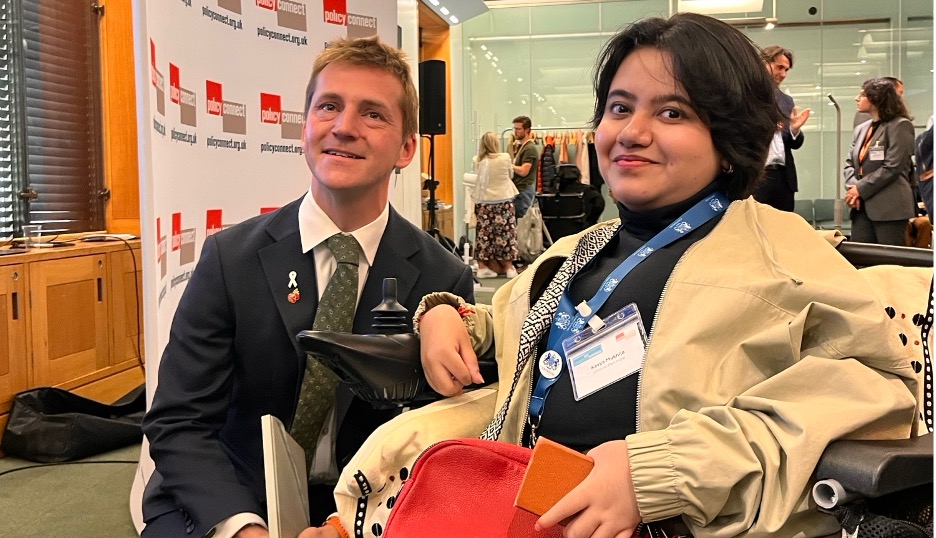
On May 8, 2025, I had the opportunity to attend the All Party Parliamentary Group for Assistive and Accessible Technology (APPGAT) Spring Reception, hosted by Policy Connect at Portcullis House in the UK Parliament. I was invited as part of the Disabled Leaders Network, alongside fellow advocates, researchers, educators, MPs, and students. The event focused on the role of assistive technology in education, especially for learners with complex communication and learning needs.
The reception opened with remarks from Josh Fenton-Glynn MP, Chair of APPGAT, who shared his own lived experience and emphasised the urgent need to address the national crisis in special educational needs and disabilities (SEND). He highlighted how assistive and accessible technologies are not optional supports, but fundamental to participation.
We then heard from Beth Moulam, a postgraduate student at the University of York, Paralympian, and AAC (Augmentative and Alternative Communication) user. Using a text-to-speech device, Beth spoke about the need to:
- Strengthen local specialist services,
- Equip professionals to engage effectively with ATech,
- Always assume competence and hold high expectations for learners with communication disabilities.
Beth closed with a quote that resonated deeply with me: “If not now, then when? And if not us, then who?”

During the reception, I had the opportunity to speak with Sir Fenton-Glynn MP about the UK caregiver visa system and how international disabled students currently fall through the cracks. Without a specific pathway for bringing essential caregivers, many disabled students are unable to access higher education in the UK, not because of their ability, but because of immigration policy. He responded with openness and promised to raise the concern further in Parliament.
Another memorable moment was meeting Laura Brown, founder of Spinning World of Autism. Laura, whose son is a non-verbal autistic child, discovered AAC following his diagnosis and is now a passionate advocate. Her presence brought warmth and humanity to the room, and her family-centred approach to advocacy challenges deficit-based narratives of disability.
The reception concluded with a compelling talk by Professor Annalu Waller OBE, a renowned AAC expert from the University of Dundee. She spoke about the everyday significance of communication, not just to express needs, but to build relationships, express humour, and navigate social spaces. She also stressed the need for systemic awareness, training, and a united voice across the sector.

Finally, Robert McLaren, Director of Policy Connect, wrapped the event up by sharing about the advocacy work championed by the APPGAT. He left the room with four areas of immediate impact: education, employment, independent living, and social care, as well as intersecting policy areas such as digital inclusion.
As a disabled leader from the Global South, I left the event feeling hopeful and energised. Advocacy around assistive technology must reflect the diverse realities of disabled people worldwide, especially those too often left out of policy conversations.
Events like this reception offer a platform not only to share stories but also to shape policy. I’m grateful to the Disabled Leaders Network for enabling this engagement and for continuing to spotlight lived experience at the heart of systems change.
Written by Kavya Mukhija
Kavya Mukhija is a member of the Disabled Leaders’ Network and is currently pursuing an MSc in Disability, Design and Innovation at UCL’s Global Disability Innovation Hub.
Leave a Reply